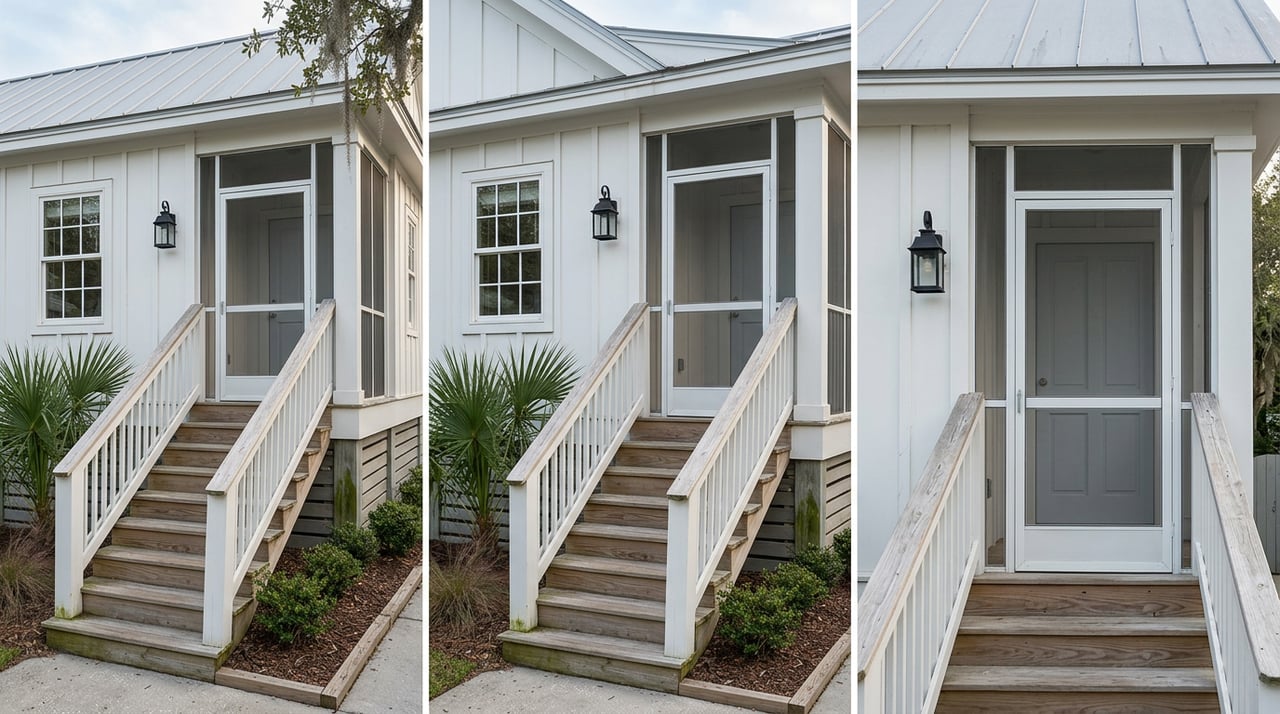
The Federal Rule Deciding Which Pawleys Island Cottages Survive
September 3, 2026
September 3, 2026
In September 2024, five members of the Pawleys Island Architectural Review Board voted down a house that did not yet exist. The design would have replaced Port Arthur, a 1940s beach cottage sharing a lot with Liberty Lodge, one of the roughly dozen Pawleys Island homes on the National Register of Historic Places. Board member Frank Robinson asked the room a plain question: "Am I the only one concerned about the square footage and the changes?" Chair Ken Leach answered just as plainly: "No, you're not." The vote came back 5-0, the first design the board had rejected since it adopted its guidelines in 2021.
It's tempting to read that vote as a town holding a hard line on history. Look closer and the real fight isn't about taste. It's about a percentage buried in federal flood insurance rules, one that can make tearing down a historic cottage cheaper than saving it. That pressure is what the town is racing to defuse right now, and it's exactly what a buyer eyeing anything labeled "historic" on Pawleys Island needs to understand before making an offer.
Because the town's zoning ordinance permits only one home per lot, the Inskeeps, who own Liberty Lodge and Port Arthur, needed to remove Port Arthur if they wanted to renovate the older house and build something new beside it. The town's Board of Zoning Appeals granted that variance on one condition: preserve Liberty Lodge's exterior appearance in perpetuity, and keep the new house's footprint no more than 50 percent larger than Port Arthur's. Port Arthur's footprint was estimated at 1,200 to 1,400 square feet. When the agreement was formally signed, that number landed at 1,425 square feet, which meant the new house could cover up to 2,183 square feet, more than half again the size of what it replaced.
That's what a "preservation agreement" bought on this particular lot: a bigger house, a saved facade next door, and a design fight that still had to clear the Architectural Review Board. It's a useful reminder that the word preservation, on a listing sheet or in a town meeting, doesn't always mean what a buyer might assume.
Here's the mechanism most listings won't mention. Pawleys Island's flood damage prevention ordinance, required for the town's participation in the National Flood Insurance Program, triggers full elevation compliance the moment renovation costs exceed 50 percent of a structure's fair market value. For a house built decades before modern flood standards existed, that threshold is easy to cross with a kitchen remodel and a couple of bathrooms. Once crossed, the owner has to bring the whole structure up to current elevation requirements, often meaning the house gets lifted onto new pilings at a cost that can rival building fresh.
By early 2026, the town's own Architectural Review Board had reviewed 20 sets of new construction plans since adopting its design guidelines in 2021, many of them replacing older homes that had already come down. That's not a coincidence of taste. It's the 50 percent rule doing exactly what it was written to do for flood safety, while quietly working against the town's separate goal of keeping its oldest cottages standing.
Town officials know this. The current push toward historic preservation started in 2024, after the undesignated demolition of an older home caught the Planning Commission's attention. Town Council funded a preservation workshop held in December 2025, then approved a Historic Preservation Special Committee in 2026 to finish the remaining steps toward becoming a state Certified Local Government: an ordinance, defined criteria for what counts as historic, a property inventory, and design guidelines. A draft Historic Preservation Ordinance began circulating in June 2026, built on a model used by the town of Sullivans Island, along with a nomination form for a new List of Local Historic Properties and a Certificate of Appropriateness process for exterior work. The town held a public hearing on the resulting measure, Ordinance 2026-02, in mid-July 2026.
The reason this ordinance matters so much comes straight from the people writing it. Commission member Paul Groce has said a historic designation would create an exemption from the flood elevation requirement for properties that get renovated, which is the specific move meant to stop owners from choosing demolition purely to avoid an expensive elevation retrofit. Until that ordinance is adopted and a given house is formally designated under it, the exemption doesn't exist. The 50 percent trigger still applies to almost every old cottage on the island.
A National Register listing sounds like protection. Brad Sauls, who runs local government assistance programs for the State Historic Preservation Office, told the Pawleys Island Planning Commission directly that the designation "is only honorific" and that there are no "mythical preservation police" enforcing it. The distinctions that actually carry legal weight are narrower and newer than most buyers assume.
| What the label means on a listing | What it actually guarantees today |
|---|---|
| Listed on the National Register (since 1972) | Honorary status only. No local legal protection against demolition. |
| Inside the Pawleys Island Historic District | Subject to Architectural Review Board design guidelines for new construction since 2021. Does not itself block a teardown of an existing house. |
| Nominated to the town's List of Local Historic Properties (pending ordinance) | Would require a Certificate of Appropriateness for exterior changes and would exempt the property from the 50 percent flood-elevation trigger, once the ordinance is adopted and the house is formally designated. |
The town's own record shows this isn't a theoretical distinction. Officials pushed to preserve Liberty Lodge while separately pressing for demolition of the former Tyson house on Myrtle Avenue, a structure town administrator Dan Newquist said had come to affect the value of its neighbors after years of complaints. Old and historic are not the same category in Pawleys Island's eyes, and a buyer needs to know which one they're looking at before falling for curb appeal.
A member of Georgetown's own review board, advising Pawleys Island's commission on how a neighboring town handles the same tension, put the mindset this way: "I'm not the owner of my property, I'm the steward." That's a fair description of what buying inside this district actually asks of someone, whether the house in question survives on charm alone or on paperwork that hasn't been finished yet.
None of this means avoid the historic district. It means treat the word historic on a Pawleys Island listing as a starting point for questions, not a finish line. The cottage that looks protected in a photo may be one renovation estimate away from a teardown, and the ordinance meant to change that outcome is still moving through Town Council as of this writing.
If you're weighing an older Pawleys Island cottage against new construction, or trying to figure out what a specific address's flood and preservation status actually means for your renovation budget, Dan Benish can walk through the Certificate of Appropriateness timeline, the elevation math, and what a given property is really worth once those factors are priced in. Get Your Home Valuation before you write an offer on anything with the word historic in the listing.
Stay up to date on the latest real estate trends.
Contact Dan today to learn more about his unique approach to real estate and how he can help you get the results you deserve.
100 Greenway Blvd Murrells Inlet, SC 29576